

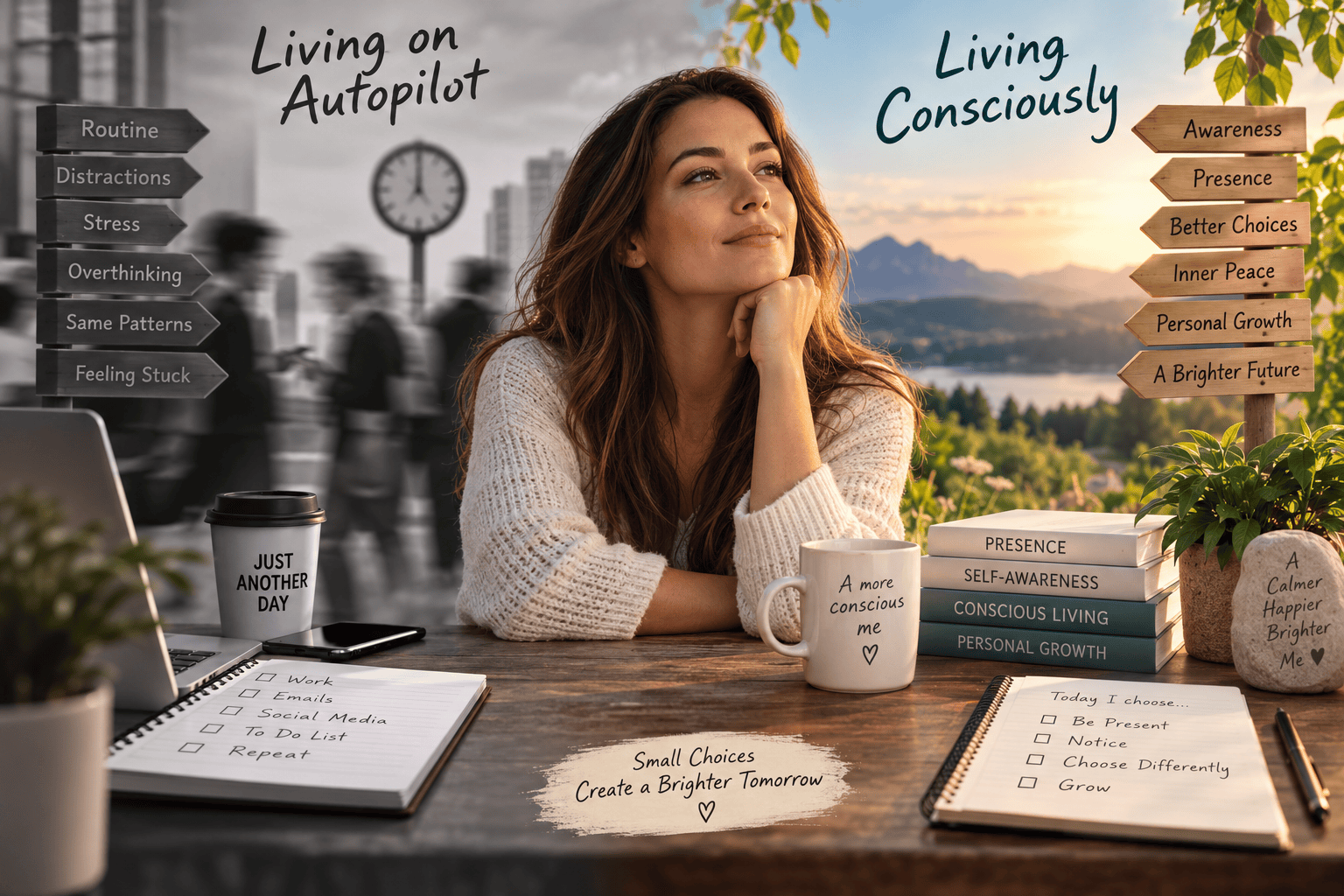
Have you ever reached the end of the day and realised you barely remember what happened? You completed your tasks, answered messages, went to work, ate meals and followed your usual routine, but somehow felt disconnected from it all.
This is what many people mean when they talk about living on autopilot.
The good news is that you do not have to completely change your life to become more present. Learning how to stop living on autopilot begins with something much simpler: becoming aware of how you are thinking, feeling and choosing in everyday moments.
At Star Magic Healing, personal transformation is centred on awareness, presence, consciousness, empowerment and reconnecting with yourself. The Star Magic approach places importance on noticing your patterns, taking responsibility for your choices and developing practices that help you return to a more conscious state.
To stop living on autopilot, start by noticing your habits, thoughts and emotional reactions without judgement. Create pauses before responding, practise mindfulness, spend more time in the present moment and build a consistent daily practice such as meditation or reflection. Conscious living develops through small, repeated choices.
Living on autopilot means moving through parts of life largely from habit rather than conscious choice.
You may wake up, check your phone, rush through your morning, complete your work, scroll through social media, eat dinner and go to bed without stopping to ask yourself what you actually need or want.
There is nothing wrong with having routines. In fact, routines can make life easier. The challenge begins when your routines, reactions and decisions happen without awareness.
You might notice yourself:
Becoming aware of these patterns is already a step towards conscious living.
The human mind naturally relies on familiar patterns. When something becomes routine, you do not need to consciously think through every step.
That can be useful, but it can also mean that old patterns continue long after you have outgrown them.
From a Star Magic perspective, this can be understood through the idea of your baseline frequency: the habitual state you naturally return to when external stimulation falls away. The wider teaching encourages people to notice the state, identity and patterns they repeatedly operate from rather than simply trying to force a different external result.
This creates an important question:
Am I consciously choosing this, or am I simply repeating what I have always done?
That question can create a pause between the old pattern and your next choice.
You do not need to become aware of every thought all day. Start with small moments of conscious attention.
Begin by observing yourself without judgement.
What do you automatically do when you feel stressed? Do you reach for your phone, become impatient, withdraw, overthink or try to control everything?
Instead of immediately changing the behaviour, simply notice it.
Awareness comes before transformation. You cannot consciously change a pattern that you have not recognised.
One of the simplest ways to stop living on autopilot is to pause.
When something triggers a strong reaction, take a breath before responding. Ask yourself:
What am I feeling? What am I assuming? What do I actually want to choose here?
This does not mean ignoring your emotions. It means creating enough space to respond consciously rather than allowing an old reaction to make the decision for you.
Autopilot often keeps attention somewhere other than the present moment.
You may be physically having breakfast while mentally replaying yesterday’s conversation. You may be talking to someone while thinking about tomorrow’s problems.
Practise bringing your attention back to what is actually happening now.
Notice your surroundings. Listen fully. Feel your feet on the ground. Take a slower breath. Give the person in front of you your attention.
These small moments can become powerful anchors for mindfulness and self-awareness.
Sometimes autopilot is not only about behaviour. It is also about identity.
You may repeatedly tell yourself:
“That’s just who I am.”
“I always do this.”
“I can’t change.”
“This is how my life has to be.”
But personal growth invites you to question these assumptions.
Ask yourself what you would choose if you were not automatically following an old story.
Star Magic’s philosophy places strong emphasis on sovereignty and self-responsibility: becoming less dependent on external circumstances to define your choices and developing your own internal toolkit.
Becoming more conscious is easier when you create regular space for it.
This could include meditation, breathwork, journalling, quiet reflection, movement or simply spending a few minutes without digital distractions.
The goal is not to achieve a perfect state.
It is to practise returning to yourself.
Star Magic’s teachings similarly emphasise daily practices,
meditation, breathwork, movement, recovery and community as part of building capacity and maintaining a stronger baseline rather than relying only on occasional peak experiences.
For some people, spiritual practices provide a useful way to explore consciousness, presence and personal transformation.
Meditation can encourage observation. Breathwork can bring attention into the body. Reflective practices can help you notice beliefs and patterns that normally operate in the background.
Within Star Magic, these practices are part of a wider exploration of consciousness and lived experience. The emphasis is not simply on understanding an idea intellectually, but on exploring it through direct experience and consistent practice.
The important thing is to find practices that genuinely support your journey and approach them with curiosity rather than pressure.
One of the biggest misconceptions about conscious living is that you should always feel calm, present and aware. Real life does not work that way. You will still become distracted, react to situations and fall back into familiar habits. The difference is that you begin to notice these patterns sooner. You may catch yourself halfway through an old reaction, recognise a familiar thought or realise that you are responding from fear rather than conscious choice. Each moment of awareness gives you an opportunity to pause, choose differently and return to the present. This is where personal transformation begins.
You do not need to redesign your entire life to stop living on autopilot.
Choose one ordinary part of your day and become fully present for it. Eat without your phone. Listen without preparing your response. Take a walk without scrolling. Sit quietly for five minutes and notice what is happening within you.
Then ask yourself:
What would my highest version of myself choose in this moment?
Over time, these small choices can create a different relationship with yourself, your habits and your life.
At Star Magic Healing, the broader philosophy is about transformation through awareness, presence, empowerment, consciousness and lived practice. The practical thread is simple: become more aware, reconnect with yourself, strengthen your inner capacity and act from a more conscious state.
Living on autopilot means going through familiar routines, thoughts and reactions without consciously noticing or choosing them. Becoming more aware of these patterns is an important part of conscious living.
Start with small moments of awareness rather than trying to change everything at once. Pause before reacting, reduce distractions, notice your thoughts and create a daily practice that brings you back to the present moment.
Yes, mindfulness can help you pay closer attention to what you are thinking, feeling and experiencing in the present moment. Regular mindfulness practice can support greater self-awareness and more conscious choices.
Many habits become automatic because they are familiar and require little conscious effort. Recognising the pattern gives you an opportunity to question whether it still supports the person you want to become.
Conscious living means becoming more aware of your thoughts, emotions, choices, relationships and everyday experiences. Rather than simply following old patterns, you learn to make decisions with greater presence and self-awareness.
Meditation can be a useful practice for developing awareness, presence and self-observation. At Star Magic, meditation is part of a broader approach to exploring consciousness and personal transformation, with individual experiences varying from person to person.
There is no fixed timeline because everyone’s patterns and experiences are different. The most useful approach is to build consistent habits of awareness and conscious choice rather than expecting an instant transformation.
Oops! We could not locate your form.
Oops! We could not locate your form.
Oops! We could not locate your form.
Oops! We could not locate your form.
Oops! We could not locate your form.
Sign up for our weekly newsletter, for inspiration and fresh content from Jerry Sargeant.
Oops! We could not locate your form.
Oops! We could not locate your form.
Sign up for our weekly newsletter, for inspiration and fresh content from Jerry Sargeant.
[mc4wp_form id=”168″]
[contact-form-7 id=”50219″ title=”Download Propesctus Form”]
[contact-form-7 id=”50219″ title=”Download Propesctus Form”]