

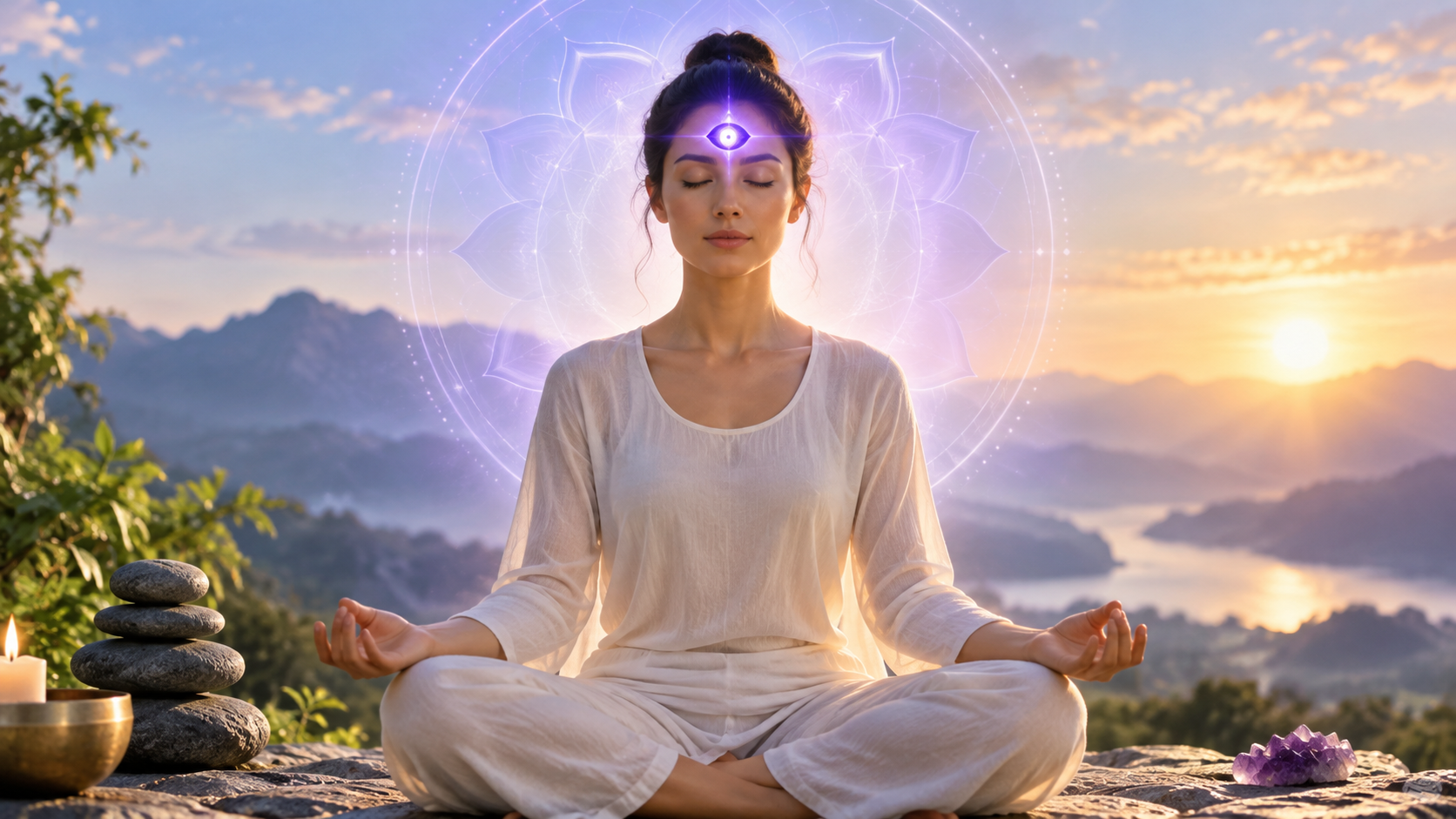
Meditation for awakening the third eye has become one of the most searched topics in modern spiritual practice, and for good reason. After more than a decade of guiding students through chakra work, one pattern stands out clearly: people rarely fail at this practice because they lack discipline.
They fail because they misunderstand what the third eye actually is, and they rush the process. This guide sets out a grounded, experience-based approach to third eye meditation, covering what it is, how to practise it safely, and what to realistically expect.
Third eye meditation is a focused practice that directs attention to the space between the eyebrows, known in yogic tradition as the seat of inner perception. Unlike general mindfulness, it uses a specific point of concentration to cultivate clarity, intuition, and heightened awareness.
The third eye is a symbolic and energetic centre associated with insight beyond ordinary sight. In yogic and Hindu traditions, it represents the point where intuition, memory, and higher perception converge. It is not a physical organ, but a concept used across multiple spiritual systems to describe non-ordinary awareness.
In the chakra system, the third eye corresponds to the ajna chakra, the sixth of the seven primary chakras. Ajna translates roughly to “command centre” and is traditionally linked to perception, discernment, and the integration of left and right brain function. Practitioners describe a balanced ajna chakra as one that supports clear judgement without clouding it with excessive imagination.
The third eye is generally located at the midpoint between the eyebrows, slightly above eye level, roughly in line with the pineal gland deep within the brain. This is why so much attention has been paid to pineal gland activation in modern spiritual writing, even though the anatomical and energetic claims are not the same thing.
Third eye meditation is typically used to sharpen intuition, improve mental clarity, and support what many describe as spiritual insight. In practice, most students come to it seeking better decision-making, reduced mental clutter, or a deeper sense of inner guidance rather than dramatic mystical experiences.
For those exploring third eye meditation as part of a deeper spiritual practice, Star Magic Healing offers another perspective on developing awareness through energy, frequency, intention and meditation. Its approach encourages people to look beyond simply seeking unusual sensations and instead use inner awareness as part of a broader journey of personal and spiritual transformation.
This is the most common question raised in consultations, and the honest answer requires nuance rather than hype.
Across Hindu, Buddhist, and Taoist traditions, the third eye is described as a dormant centre that can be gradually developed through sustained practice, ethical conduct, and disciplined attention. None of these traditions present it as something switched on overnight. For those wanting a structured entry point, it helps to understand how to open your third eye before attempting advanced techniques.
Regular meditation reliably improves attention span, emotional regulation, and self-awareness. These are well-documented psychological benefits, and they overlap significantly with what practitioners describe as third eye development, even if the terminology differs.
There is no single universally superior technique, but certain structures consistently produce better outcomes for beginners. This is part of what makes third eye activation a gradual process rather than a single session event.
A short, focused ten-minute session can be a practical way to build concentration without making the practice feel overwhelming. Begin with a few minutes of slow, natural breathing, then gently bring your attention to the area between your eyebrows.
Consistency matters more than duration in the early stages, so regular ten-minute sessions can help you develop a comfortable and sustainable meditation routine.
Sit in a quiet space, dim the lighting, and allow at least ten minutes without interruption. Loose clothing and an upright spine support longer, more comfortable sessions. Switching off phone notifications beforehand removes one of the most common sources of disrupted practice, and a small cushion under the hips can ease strain on the lower back during longer sits.
Close the eyes and bring attention to the point between the eyebrows. Breathe slowly through the nose, allowing the mind to settle without forcing any particular sensation. Maintain this focus for the full duration, gently returning attention whenever it wanders.
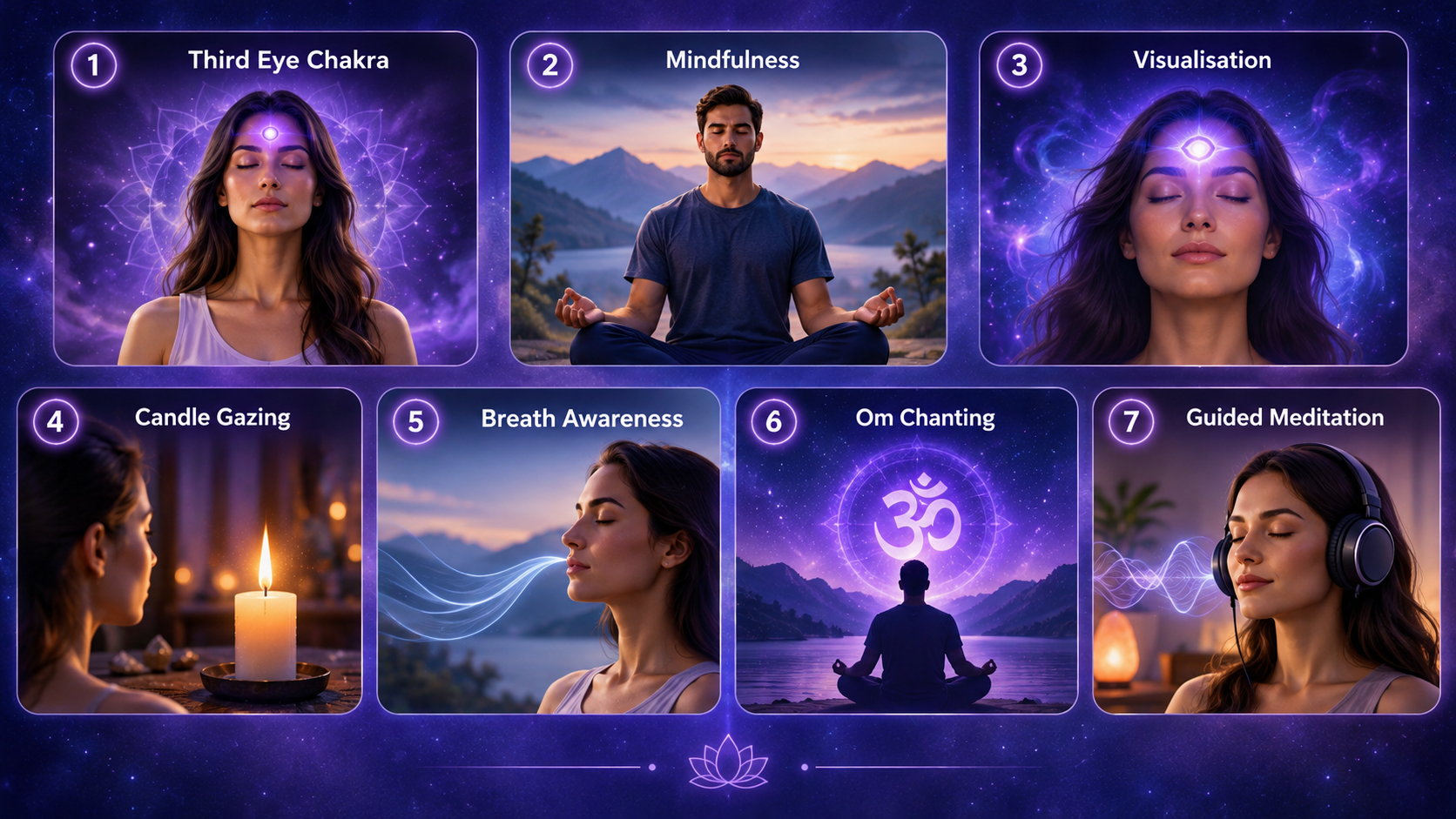
Different techniques suit different temperaments, experience levels, and meditation goals. Some practices focus on concentration, while others use breath, visualization, sound, or guided instruction to help you develop greater inner awareness.
You do not need to practise every technique at once; start with one that feels comfortable and gradually explore other approaches as your practice develops.
Those wanting a fuller breakdown of movement-based practice can review these third eye exercises alongside seated meditation.
Third eye chakra meditation involves bringing your attention gently to the area between your eyebrows while maintaining slow, steady breathing. You can combine this focus with a visualization of an indigo light or soft glow at the brow point, traditionally associated with the Ajna chakra.
Rather than trying to force a particular sensation or experience, allow your attention to rest comfortably in this area. Practising regularly can help develop concentration, self-awareness, and a deeper sense of inner reflection.
Mindfulness meditation provides a simple foundation for anyone beginning a third eye practice. Instead of concentrating on a specific image or sensation, you observe your breathing, thoughts, emotions, and physical sensations as they arise without immediately reacting to them.
This can help reduce mental distraction and make it easier to maintain focused attention during more targeted third eye practices. If you are new to meditation, starting with five to ten minutes of mindfulness can be a gentle way to build consistency.
Third eye visualization uses mental imagery to create a focused point of attention during meditation. Close your eyes and imagine a soft indigo, violet, or white light around the area between your eyebrows, allowing the image to remain gentle rather than forcing it to become vivid.
You can imagine the light becoming slightly brighter with each slow breath while keeping your body relaxed. This practice can be particularly appealing if you naturally respond well to imagery and visualization exercises.
Trataka is a traditional yogic concentration practice that involves calmly gazing at a fixed point, commonly a candle flame, for a period of time. After gazing, you can close your eyes and observe the afterimage of the flame without trying to control it.
The practice encourages sustained attention and can be incorporated into a broader third eye meditation routine. Beginners should keep the practice comfortable and stop if their eyes become strained, dry, or uncomfortable.
Breath awareness meditation is one of the simplest ways to settle the mind before focusing on the third eye. Sit comfortably and bring your attention to the natural movement of your breath, noticing each inhale and exhale without trying to change it.
As distracting thoughts arise, gently return your attention to the breath and allow your mind to become quieter naturally. Once you feel settled, you can introduce gentle awareness of the brow area for a more focused third eye practice.
Om, or Aum, meditation incorporates the repetition of a traditional mantra into your practice. You can quietly repeat the sound on each exhale, listening to the vibration and allowing your attention to remain steady rather than concentrating on producing a particular physical sensation.
Some practitioners combine Om chanting with gentle awareness of the area between the eyebrows. This approach can be useful for people who find that sound and repetition make it easier to maintain focus during meditation.
Guided meditation can be especially helpful if you are new to third eye practices or find it difficult to maintain focus during silent meditation. A teacher or recorded meditation can provide instructions for breathing, visualization, relaxation, and attention, giving you a clear structure to follow from beginning to end.
This can make it easier to develop a regular practice without worrying about what you should do next. For a structured approach, you can explore this guided third eye activation meditation.
Guided meditation can also become part of a wider energy-healing practice. Star Magic Healing combines meditation with breathwork, frequency, visualisation and intention to support deeper awareness and personal transformation. For practitioners exploring the third eye, this broader approach can provide a way to connect meditation with emotional balance, spiritual growth and greater self-awareness.
Choosing the right approach depends on experience level, goals, and available time. Reviewing how to build a personalised routine, including how to activate your third eye , helps narrow the options.
Best Third Eye Meditation for Beginners: Breath awareness paired with brief brow-point focus offers the gentlest entry point.
Best Meditation for Intuition and Inner Awareness: Visualisation combined with journaling afterwards tends to sharpen intuitive insight most reliably.
Best Meditation for Focus and Clarity: Trataka is particularly effective for concentration, though it should be introduced gradually to avoid eye strain.
Best Guided Third Eye Meditation: Guided sessions with clear pacing suit those who find silent practice difficult to sustain.
Best Third Eye Meditation Before Sleep: Slow visualisation without vigorous breathwork is best reserved for the evening, since stimulating techniques can interfere with sleep onset.
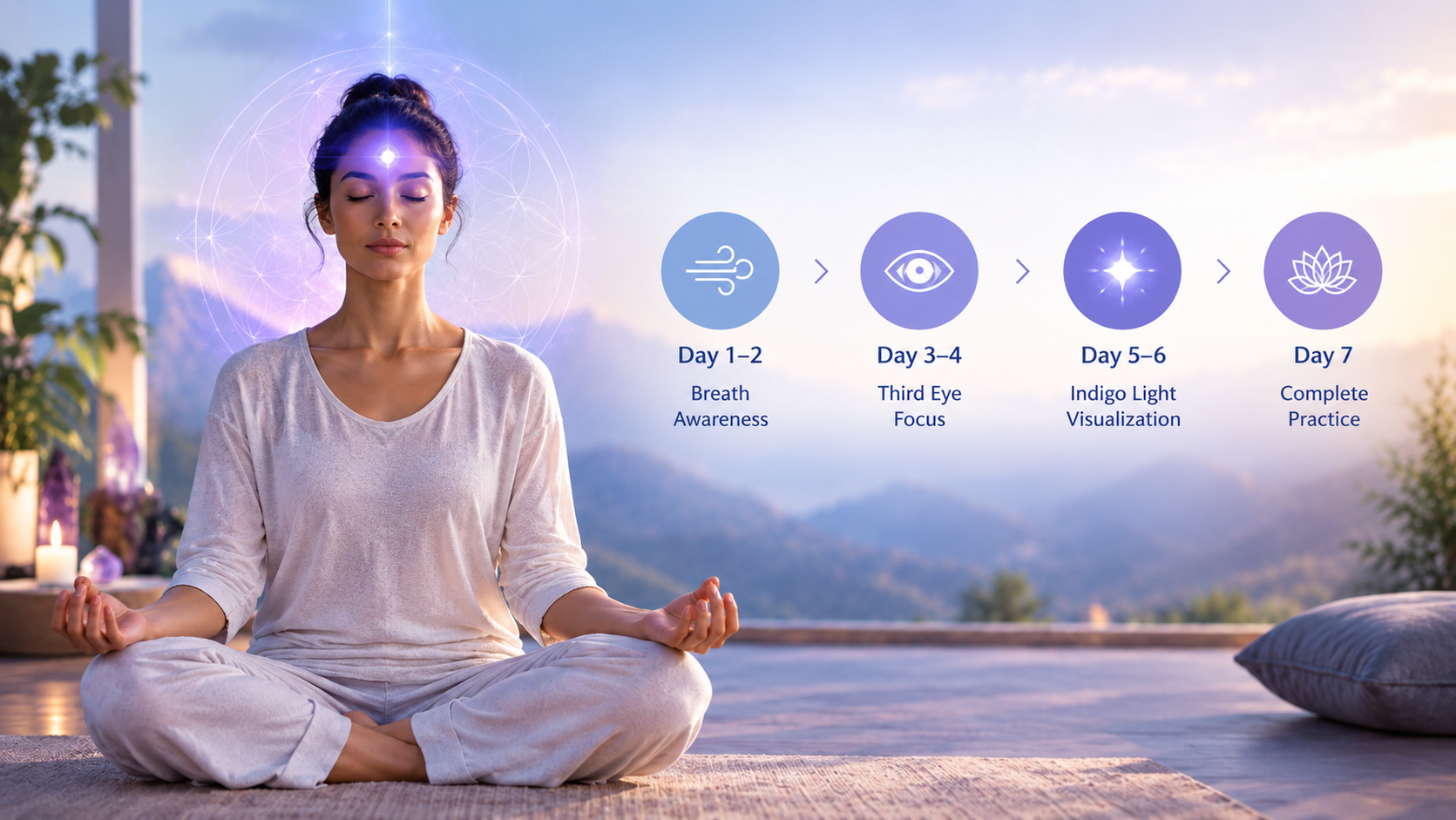
A structured week can help you build confidence and consistency without overwhelming you with too many techniques at once. The aim is to gradually develop concentration, awareness, and comfort with third eye meditation rather than trying to achieve a dramatic experience in a short time. Set aside a quiet period each day and practise at a pace that feels comfortable for you.
Begin with five to ten minutes of simple breath awareness each day. Sit comfortably, keep your spine relaxed and upright, and pay attention to the natural rhythm of each inhale and exhale without trying to control your breathing.
If your mind wanders, gently bring your attention back to the breath. This first step helps create the calm and focused foundation needed for more targeted meditation.
Once you feel comfortable focusing on your breath, introduce gentle awareness of the area between your eyebrows. Continue breathing naturally while allowing your attention to rest softly at the brow point for several minutes.
There is no need to concentrate intensely or look for a particular sensation. If your attention wanders, simply return to the breath and then gently reconnect with the brow area.
During your meditation, add a simple visualization after settling into your breathing and brow-point focus. Imagine a soft indigo or violet light at the centre of your forehead and allow the image to remain relaxed and natural.
You can picture the light becoming slightly brighter with each breath while keeping your body and facial muscles relaxed. If you find visualization difficult, simply return to breath awareness rather than forcing yourself to create a vivid image.
On the seventh day, bring the techniques together into one gentle fifteen-minute session. Begin with several minutes of breath awareness, followed by brow-point focus and a few minutes of indigo-light visualization.
Finish by sitting quietly and observing your thoughts, sensations, or emotions without trying to interpret or control them. Take a moment to ground yourself at the end of the practice and notice how you feel before returning to your normal activities.
Ten to twenty minutes per session is sufficient for most beginners; longer sessions offer diminishing returns without a stronger foundation.
Four to five sessions per week produce more consistent results than sporadic daily marathons.
Morning sessions tend to sharpen focus for the day ahead, while evening sessions support relaxation and reflection.
Only extend session length once the current duration feels comfortable and unforced, typically after two to three consistent weeks.
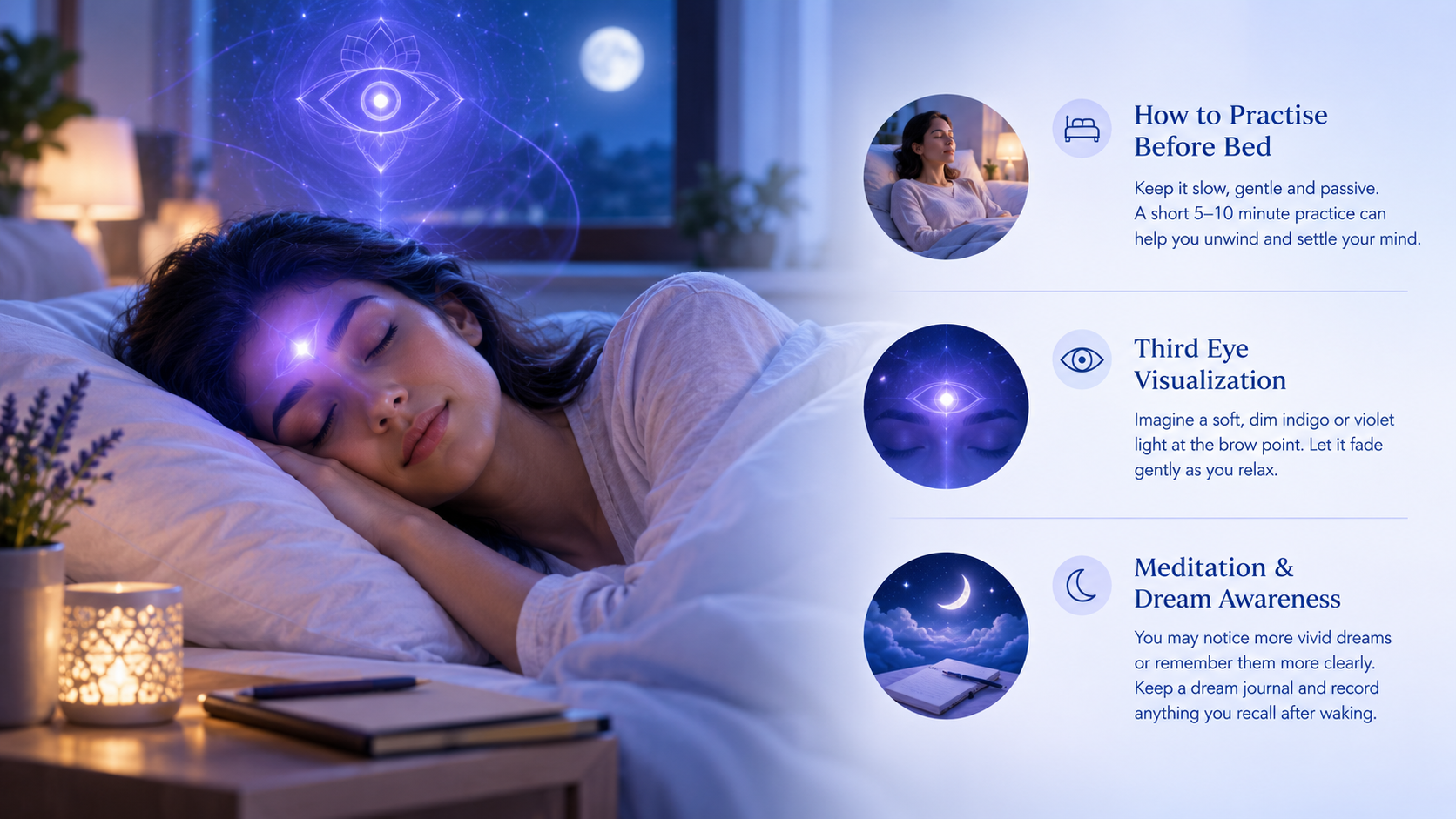
Before bed, keep your third eye meditation slow, gentle, and passive so it supports relaxation rather than alertness. Sit or lie comfortably, breathe naturally, and bring your attention softly to the area between your eyebrows without forcing concentration. A short five- to ten-minute practice can be enough to settle the mind before sleep.
For a sleep-focused practice, imagine a soft, dim indigo or violet light resting around the brow point. Allow the image to remain gentle and unfocused rather than trying to make it brighter or more intense. As you continue breathing naturally, let the visualization gradually fade into the background as your body and mind become more relaxed.
Consistent evening meditation may help some people become more aware of their dreams or remember them more clearly, although experiences vary significantly between individuals. If you notice changes in your dreams, you can keep a simple dream journal beside your bed and record anything you remember immediately after waking.
Treat vivid dreams as part of your personal meditation experience rather than assuming they have a specific spiritual meaning.
Third Eye Meditation and Spiritual Experiences: Many practitioners report vivid inner imagery during deep sessions, which they interpret through a spiritual lens.
Visions, Dreams and Mental Imagery: These experiences are best understood as heightened mental imagery rather than confirmed external phenomena, and should be treated with appropriate scepticism.
Intuition vs. Imagination: Distinguishing genuine intuitive insight from imaginative projection is a skill that develops with experience, not something guaranteed by any single technique.
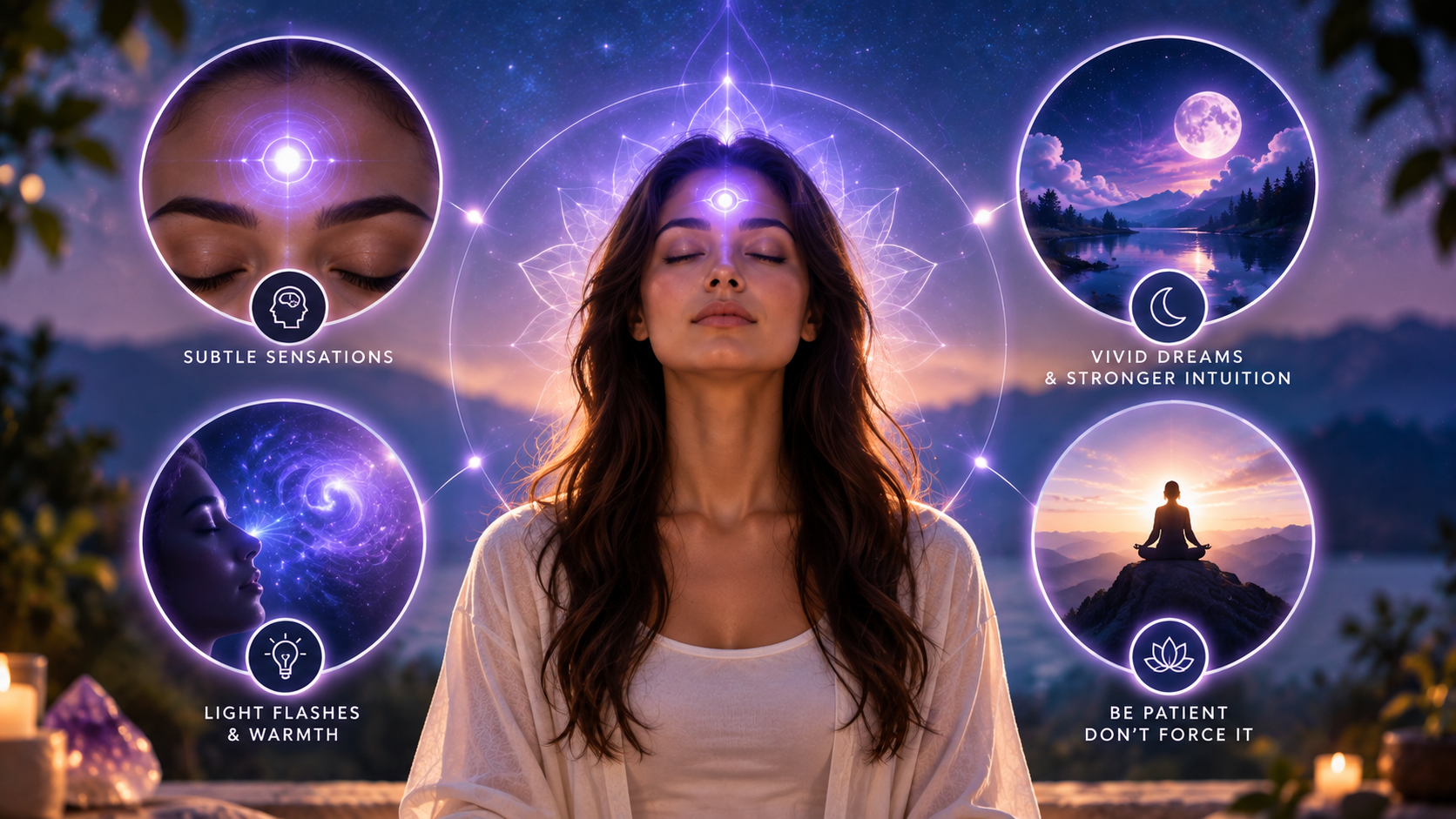
Common Meditation Experiences: Most practitioners report subtle pressure or tingling at the brow point, along with a sense of mental spaciousness.
Sensations You May Notice: Light flashes behind closed eyes, warmth, or a gentle pulsing sensation are commonly reported, though experiences vary widely.
Changes in Dreams and Intuition: Some practitioners notice sharper intuitive hunches or more vivid dreaming after sustained practice. For a broader picture of related shifts, it is worth reviewing the wider signs of spiritual awakening.
Why You Should Not Force an Experience: Forcing sensations or expecting dramatic visions often leads to frustration and, in some cases, mild dissociation. Patience consistently outperforms intensity in this practice.
Grounding After Third Eye Meditation: Simple grounding techniques, such as feeling the feet on the floor or eating something after a session, help stabilize an overactive third eye chakra.
What to Do If Meditation Feels Overwhelming: Shorten sessions, return to breath-only practice, and avoid intensive techniques like extended trataka until stability returns.
Balancing Intuition With Critical Thinking: Intuitive insight should always be weighed against practical judgement rather than accepted uncritically.
A balanced approach is also central to the Star Magic Healing philosophy, which views personal transformation as an ongoing process rather than something that needs to be forced. Its energy-healing work focuses on frequency, intention and awareness while encouraging people to reconnect with their own inner wisdom. This complements the article’s emphasis on patience, grounding and discernment.
Trying to Force Your Third Eye Open: Straining the eyes or mind to produce sensations often causes headaches rather than progress, a sign of a blocked third eye chakra reacting to pressure rather than opening.
Chasing Visions or Unusual Sensations: Treating meditation as a search for dramatic phenomena distracts from its genuine benefits.
Confusing Imagination With Intuition: Not every mental image carries meaning; discernment is essential.
Meditating for Too Long: Extended sessions without proper grounding can leave practitioners feeling disoriented rather than clear.
Neglecting Grounding: Skipping grounding after intense sessions is one of the most frequently observed errors among enthusiastic beginners, and it is often the reason someone reports feeling foggy or emotionally raw for hours afterwards. Building a short grounding routine into every session, however brief, prevents most of this discomfort.
For those interested in exploring energy awareness and consciousness more deeply, Star Magic Healing offers a structured approach that brings together meditation, frequency work, and energetic practices. This multidimensional approach can complement a third eye meditation practice by encouraging greater self-awareness, intuitive exploration, and a deeper connection with personal and spiritual transformation.
Book a Star Magic Healing session to explore intuitive awareness, multidimensional healing, and frequency-based consciousness practices as part of your spiritual journey.
Jerry Sargeant is a Frequency Architect and founder of Star Magic Healing, a next-level modality at the intersection of science, consciousness, and multidimensional transformation. Through high-frequency codes, geometric light structures, and quantum intelligence, he activates dormant DNA, restores coherence to the human energy field, and reawakens the original design embedded within the body’s bio-circuitry.
His work is a living transmission that reconditions the nervous system, upgrades inner architecture, aligns the intelligence of the soul field and unlocks deep energetic sovereignty.
Jerry has facilitated transformational experiences for thousands globally, including CEOs, doctors, athletes, and conscious creators, aligning them with the intelligence of their own soul field and unlocking performance, clarity, and deep energetic sovereignty.
A revolutionary system merging quantum physics and multidimensional awareness. Experience deep transformation through workshops, facilitator trainings and live energy transmissions – online and across the world. Star Magic empowers individuals to access their Superhuman potential and remember who they truly are.
There is no single best meditation for everyone. Beginners can start with breath awareness and gentle focus between the eyebrows, then explore visualisation or guided meditation as their practice develops.
For beginners, regular short sessions can be easier to maintain than occasional long practices. Try meditating for around 5–10 minutes several times a week and increase the duration as you become comfortable.
Some practitioners describe vivid imagery or unusual experiences during meditation, but these should not be treated as proof of seeing spirits. Meditation can increase awareness of thoughts, sensations, and mental imagery.
Third eye meditation can be approached gently by beginners when sessions remain comfortable and relaxed. Avoid forcing concentration or continuing if you experience significant discomfort, dizziness, anxiety, or eye strain.
Yes, a gentle sleep meditation for opening the third eye can be included in a bedtime routine. Use relaxed breathing and soft visualisation rather than stimulating breathwork, and stop if the practice makes you more alert.