

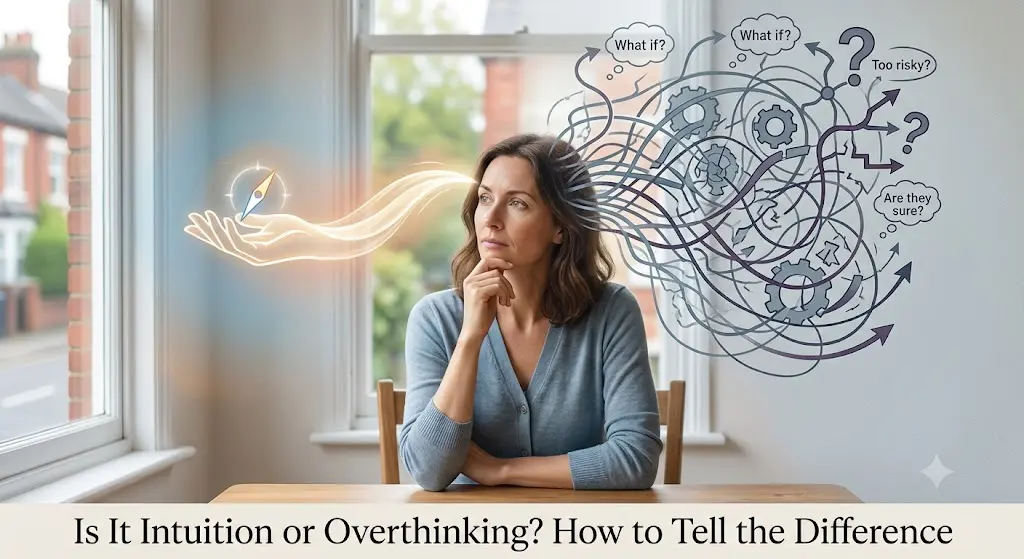
Have you ever had a feeling that something was not quite right, only to spend hours questioning whether you were sensing something important or simply thinking too much? Perhaps you replayed a conversation, worried about a decision or felt pulled towards an opportunity without knowing exactly why.
Understanding intuition vs overthinking can help you approach these moments with greater awareness. Intuition is often described as an inner feeling or sense of knowing, while overthinking involves repeatedly analysing possibilities, doubts and potential outcomes. Although they can feel similar, learning to recognise your thought patterns may help you make decisions with more clarity.
At Star Magic Healing, learning to distinguish intuition from mental noise is an important part of the work. Jerry often describes the heart as your life compass, while the mind can sometimes keep you going around in circles, revisiting the same questions without finding clarity. The Infinity Membership offers regular meditations, breathwork, live sessions and community support to help you practise reconnecting with a clearer, more coherent inner signal. For those who want to explore this awareness more deeply, Online Facilitator Training helps you develop the ability to notice what you notice, trust your inner knowing and work from the heart rather than trying to force an answer through the mind. You can also explore Star Magic Healing Sessions to learn more about the healing support available.
Intuition is a personal experience in which you feel drawn towards something or sense that a situation deserves your attention, sometimes without immediately understanding why. It may develop through past experiences, subtle observations or information you have not consciously considered.
For example, you might feel comfortable around someone because their behaviour seems consistent and familiar, even before you can explain exactly why. Alternatively, you may notice a sense of unease and decide to pay closer attention to what is happening.
Overthinking, by contrast, often involves getting caught in repeated mental loops. You might revisit the same question, imagine multiple negative outcomes or search for complete certainty before making a decision. Instead of helping you move forward, the analysis can leave you feeling more confused.
However, there is no universal rule that intuition always feels calm or that overthinking always feels anxious. Intuitive impressions can be influenced by fear, past experiences and assumptions, while careful analysis can be genuinely useful. The aim is not to label every feeling immediately, but to understand it before acting.
A useful first step is to observe what happens after a thought appears.
An initial feeling might prompt you to consider a situation more carefully. Overthinking often begins when you keep returning to the same question without gaining any new information. You may replay what someone said, imagine what they meant and repeatedly question your own interpretation.
Ask yourself: Am I learning something new by thinking about this, or am I repeating the same possibilities?
If the thought is going in circles, take a pause. You can return to the question later when you feel more settled.
Feelings can provide useful information about your experience, but they do not automatically establish what is happening around you.
Suppose a friend takes longer than usual to reply to your message. You might feel uneasy and interpret the delay as a sign that something is wrong. But there could be several explanations, including being busy, tired or distracted.
Before acting on your interpretation, separate the facts from the story your mind has created.
This simple practice helps you respect your feelings without allowing uncertainty to become a conclusion.
Strong emotions can influence how you interpret situations. Stress may make a possibility feel threatening, while excitement can make an opportunity seem more certain than it really is.
When a feeling is particularly intense, give yourself time to notice it before making a significant decision. A few quiet minutes, slow breathing or writing down your thoughts may help you understand what is influencing your response.
You do not need to dismiss a feeling because you are emotional. Instead, recognise the emotion and consider whether it is highlighting something worth exploring or making a particular outcome feel more likely than the evidence suggests.
If you repeatedly feel uncomfortable in a particular situation, it may be worth exploring why. Perhaps certain behaviours conflict with your values, or an experience reminds you of something difficult from the past.
Rather than assuming the feeling proves something, look for observable patterns. What has actually happened? Is there consistent behaviour supporting your concern? Could previous experiences be influencing how you interpret the present?
Reflection can help you identify what deserves attention while remaining open to other explanations.
Not every decision needs an immediate answer. When you feel caught between intuition and overthinking, step away from the question if possible.
Go for a walk, write down the options or discuss the situation with someone you trust. Once the initial intensity has passed, review what you know, what remains uncertain and what matters most to you.
You may not achieve complete certainty, and that is normal. Sometimes, a thoughtful decision means choosing the most reasonable next step with the information available.
In Star Magic language, conscious awareness is about becoming more sensitive to the signal you are running. When the nervous system is calmer and the mind is less noisy, it can become easier to notice the difference between a repetitive thought loop and a quieter inner knowing. This is one reason daily practice matters: Infinity helps people stay plugged into meditation, breathwork and live frequency work, while Facilitator Training develops the habit of observing, feeling and knowing before acting.
For instance, instead of immediately reacting to a worrying thought, you might notice, “I am feeling uncertain, and my mind is exploring several possible outcomes.” That small shift helps you recognise the experience without treating every thought as an instruction.
You can explore practical ways to develop this habit through Star Magic Healing’s guide to bringing conscious awareness into everyday life.
Meditation may also provide time for reflection. If you are exploring different approaches, the article on guided meditation vs silent meditation can help you consider which style feels more suitable for your routine.
These practices are not about eliminating thoughts or forcing yourself to feel peaceful. They offer opportunities to become more familiar with your inner experiences and respond more deliberately.
Learning to distinguish intuition from overthinking does not mean you must choose between trusting yourself and thinking logically. Both reflection and evidence have a place in making sound decisions.
You can acknowledge an inner feeling, investigate what may be contributing to it and consider the available facts before deciding how to respond. For significant decisions involving relationships, finances, work or wellbeing, it is particularly important to consider practical information and seek appropriate advice when needed.
Star Magic Healing encourages you to become more curious about your inner experience without handing your authority to every thought that appears. The aim is not blind belief. It is deeper knowing, greater coherence and a more conscious relationship with your own signal, while still staying grounded in the facts in front of you.
The next time you wonder whether you are experiencing intuition or overthinking, pause and ask yourself three questions:
You may not find an immediate answer, but you can create space for a clearer response. Over time, understanding your own patterns can help you approach uncertainty with greater confidence, curiosity and self-trust.
Notice whether you are gaining useful information or repeating the same worries. Consider your emotional state, the facts available and whether your interpretation is supported by observable patterns.
Yes. Intuitive feelings can be influenced by assumptions, stress, past experiences and incomplete information. Treat them as impressions worth considering rather than infallible answers.
No. You can acknowledge the feeling without immediately acting on it. Explore what may have triggered it, consider the evidence and decide what response is appropriate.
Meditation can offer an opportunity to observe thoughts without immediately reacting to them. It does not guarantee that overthinking will stop, but regular practice may help you develop a more reflective relationship with your thoughts.
Oops! We could not locate your form.
Oops! We could not locate your form.
Oops! We could not locate your form.
Oops! We could not locate your form.
Oops! We could not locate your form.
Sign up for our weekly newsletter, for inspiration and fresh content from Jerry Sargeant.
Oops! We could not locate your form.
Oops! We could not locate your form.
Sign up for our weekly newsletter, for inspiration and fresh content from Jerry Sargeant.
[mc4wp_form id=”168″]
[contact-form-7 id=”50219″ title=”Download Propesctus Form”]
[contact-form-7 id=”50219″ title=”Download Propesctus Form”]