
Spiritual coaching has moved from a niche interest into a recognised career path, with client demand for purpose-driven guidance growing steadily over the past decade. For anyone researching how to become a spiritual life coach, the process involves far more than adopting a title; it requires personal development, structured training, and a clear understanding of professional boundaries.
This guide explains what spiritual life coaching is, how people typically train for it, what to look for in a credible course, and how the Star Magic Facilitator pathway offers a broader route for those drawn to energy awareness, consciousness, intuition and practical facilitation.
Many people arrive at this path after their own experience of change, whether through meditation, therapy, breathwork, spiritual practice or a significant life event. That personal history can be valuable, but supporting others also requires structure, consistency, practice and the ability to hold space responsibly.
A spiritual life coach supports clients in exploring purpose, values, and inner alignment, independent of any specific religious doctrine. The work blends coaching competencies, such as reflective questioning and client autonomy, with practices drawn from mindfulness, shadow work, and archetypal psychology.
Many practitioners incorporate Jungian spiritual coaching concepts, including the individuation process, to help clients integrate different parts of themselves rather than simply setting goals.
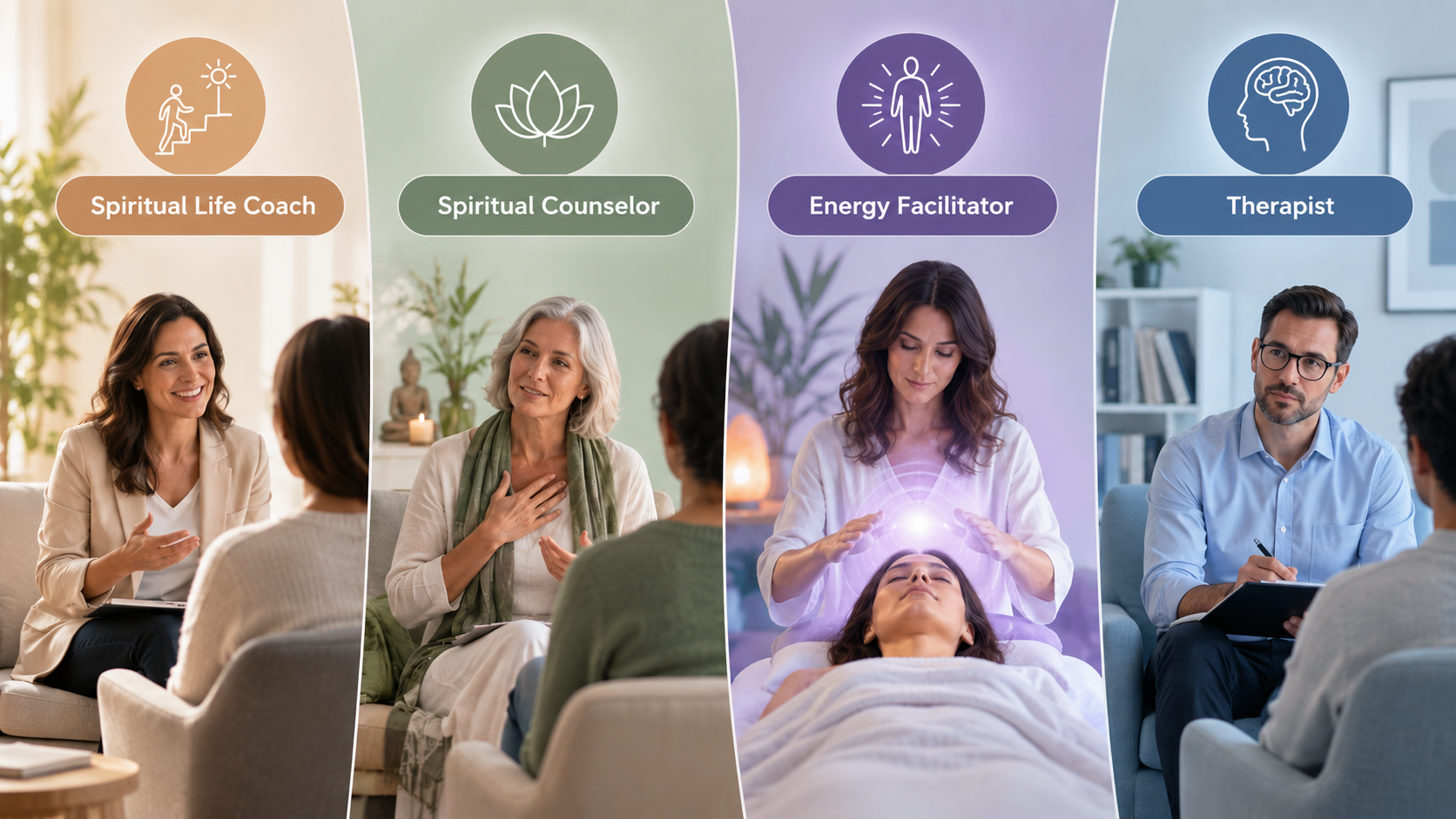
A spiritual life coach helps clients explore their purpose, values, personal growth, and sense of inner alignment. Their work is generally non-clinical and may involve tools such as reflective questioning, mindfulness, and other personal development practices. A spiritual life coach focuses on helping clients gain clarity and make their own decisions rather than diagnosing or treating medical or mental health conditions.
A spiritual counselor focuses primarily on meaning-making, personal reflection, and navigating life transitions. Their approach may include guided conversations, spiritual practices, or rituals, depending on their training and approach. Like spiritual life coaching, spiritual counseling is generally non-clinical and should remain within the practitioner’s defined scope of practice.
An energy facilitator focuses on subtle energy practices and may use approaches such as breathwork and visualisation. The role is non-clinical and is generally centred on spiritual or energetic practices rather than diagnosing or treating health conditions. Practitioners should clearly communicate what their sessions involve and maintain appropriate professional boundaries.
A therapist is a licensed clinical professional whose role can include assessing, diagnosing, and treating mental health or other conditions within the scope of their professional license. Therapists use evidence-based clinical methods and operate within regulated professional standards. Spiritual life coaches, spiritual counselors, and energy facilitators should not present their services as a substitute for licensed therapy or other qualified medical care.
This distinction matters because clients frequently confuse these roles, and a coach who cannot explain the difference risks operating outside their scope of practice.
There is no single required background. People enter spiritual coaching and facilitation from many different paths, including wellness, business, therapy-adjacent work, healing modalities, fitness, education and completely different professional careers. You also do not have to begin as an experienced energy practitioner. Some people prefer to build a foundation first, while others feel ready to enter a deeper training environment immediately. What matters is a willingness to practise, develop self-awareness, learn responsibly and stay within a clear scope of practice.

Effective spiritual coaches help clients strengthen their own awareness and decision-making rather than simply giving answers. That requires presence, listening, emotional regulation and the ability to ask useful questions without projecting personal beliefs or unresolved material onto the client.
Sessions may draw on breathwork, guided imagery, meditation, reflective questioning and other consciousness-based practices. Star Magic takes a more experiential approach to these areas, with a strong emphasis on direct awareness of energy, intuition, nervous-system work, visualisation and consciousness rather than theory alone.
Delivery formats range from private sessions to group work and remote facilitation. Group formats scale a practice’s reach, while remote sessions widen the potential client base beyond a single geographic area.
A common early mistake is offering all three formats simultaneously before any one of them is fully refined. Experienced practitioners generally recommend mastering one-on-one facilitation first, since it surfaces gaps in technique and pacing that are far harder to notice when managing a group.

Before guiding others, build your own foundation through regular practice. This might include meditation, breathwork, reflection, journalling, energy-awareness practice or another disciplined form of inner development. There is no universal rule that you must practise for a fixed number of months or years before training.
What matters more is consistency, self-awareness and a willingness to keep practising as you develop professionally. Within Star Magic, the training is intended to be lived and experienced rather than learned only as theory.
Spiritual life coach certification varies widely in quality and approach. Look beyond the certificate itself. Review the curriculum, the experience of the trainers, the practical work involved, the support available and whether the training matches the type of work you actually want to do. For some people, a conventional coaching course will be the right fit. For others, the deeper interest is energy, consciousness, intuition and facilitation, which is where the Star Magic pathway becomes relevant.
Practical competence develops through experience. Depending on the pathway you choose, that may include visualisation, meditation, breathwork, symbolic geometry, energy awareness and structured facilitation exercises.
Star Magic encourages students to explore these through direct experience. The aim is to develop awareness, intuition and practical confidence rather than simply collecting information.
Good training should give you opportunities to practise, reflect and improve. Feedback may come through trainers, peers, live sessions, community support or ongoing practice groups depending on the programme. Remote practice is also increasingly relevant because many coaches and facilitators now work with clients online.
Every session should begin with a clear agreement covering scope of practice, confidentiality, and referral protocols. Skipping this step is one of the most common mistakes among newly certified coaches.
A written agreement should also specify session length, cancellation terms, and what happens if a client discloses something outside the coach’s competence.
Coaching packages, rather than single sessions, can provide a clearer structure for clients because transformation work typically unfolds over several weeks.
A simple three-tier structure, such as a single discovery session, a four-week package, and a twelve-week programme, can make it easier for prospective clients to understand the available options.
If you are completely new to energy work, NEST provides an accessible foundation before Facilitator Training Level 1. It introduces students to feeling, seeing and sensing energy, working with visualisation and holographic awareness, opening the heart and becoming more comfortable with the Star Magic approach.
Facilitator Training Level 1 is where the deeper Star Magic pathway begins for many people. The training explores energy awareness, intuition, visualisation, nervous-system work, light and sound codes, geometry, holographic awareness and practical Star Magic facilitation ways.
Ongoing mentorship and community support help facilitators refine their approach well beyond initial certification, which is often where genuine competence develops.
Accreditation can be useful where it is relevant to your intended career path, but a certificate alone does not make someone a capable practitioner. Practical experience, self-awareness, ethical boundaries and continued development matter as well.
Self-paced formats suit those balancing existing commitments, while in-person immersion can provide direct feedback and a more interactive learning environment.
A certificate can show that you completed a programme. Competence develops through practice, self-awareness, feedback and continued learning.
Spiritual life coach earnings vary considerably by experience, niche, location, client base, pricing and delivery format. Some coaches charge by the hour, while others use multi-week programmes, memberships, workshops or group services.
There is no guaranteed income level, and building a sustainable practice normally takes time. Results depend on skills, positioning, reputation, marketing, client retention and the type of services offered.
Rather than relying on broad salary claims, create realistic projections based on your own service prices, client capacity, business costs and expected marketing activity.
Becoming a spiritual life coach rewards people who prioritise depth over labels. Genuine competence develops through personal practice, real experience, ethical boundaries and continued learning. For some people, conventional spiritual coaching will be the right path. For others, the search for spiritual life coach certification can be the first step into something broader.
If you are drawn to energy awareness, consciousness, intuition and practical facilitation, Star Magic Facilitator Training offers a pathway that extends beyond traditional coaching and into what Star Magic describes as a technology for life.
His focus is helping people remember their own potential, develop greater awareness and learn practical ways they can use in their own lives and, if they choose, in work with others.
Star Magic Healing is a consciousness and energy-based personal-development system offering facilitator trainings, workshops, meditations, memberships and live experiences online and around the world. Its central philosophy is that Star Magic is not only a healing modality but a technology for life, designed to help people explore their potential, develop greater awareness and remember who they truly are.
Requirements vary by provider and location, but a spiritual life coach training course can offer structured learning, supervised practice, ethics guidance, and practical skills for supporting clients responsibly.
Spiritual life coaching focuses on purpose, values, self-awareness, and personal growth, while therapy addresses mental health and clinical needs. Coaches should stay within their scope and refer clients when appropriate.
Look for spiritual life coach certification with a clear curriculum, experienced trainers, supervised practice, ethical guidelines, and transparent course details. Choose training that matches your goals and intended client work.
Yes, many spiritual life coaches offer online coaching through video sessions, guided practices, and follow-up. Remote training can also develop facilitation skills when the course includes practical sessions and useful feedback.
Income varies by experience, niche, location, pricing, demand, and delivery model. Instead of relying on fixed salary claims, create realistic projections based on your services, marketing, expenses, and client capacity.